Plan sealing · Operational works
Operational Works Approvals and Plan Sealing
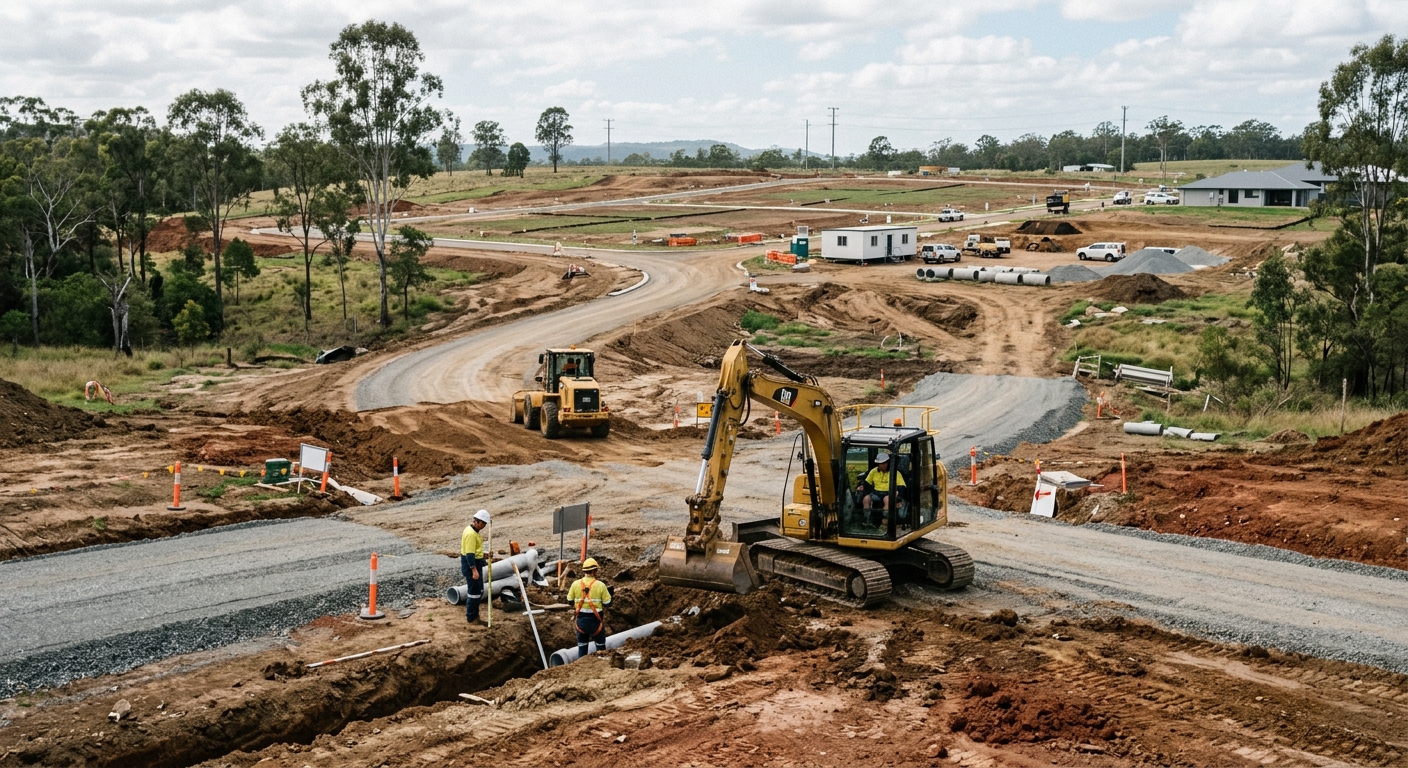
On a subdivision, operational works are the civil works that turn approved lots into serviced land: roads, drainage, earthworks and services. Those works have to be designed, approved, built and certified before a council will seal the plan, which makes operational works one of the biggest determinants of when a subdivision can settle.
Operational works (often abbreviated to OPW) are the physical civil works required to service a subdivision. In Queensland, operational work is one of the categories of development defined under the Planning Act 2016, and a development permit for operational works is typically required for the roads, stormwater drainage, earthworks, services and landscaping a subdivision depends on. Because a council will not seal a survey plan until the operational works conditions are satisfied, the operational works program sits directly on the path to plan sealing.
What operational works means
Operational work is defined under the Planning Act 2016 as work, other than building work or plumbing or drainage work, in, on, over or under premises that materially affects the premises or the use of premises. On a subdivision, that definition captures the civil construction that makes raw land into serviced lots. Councils including Redland and Brisbane describe operational works for a reconfiguring a lot as covering road and drainage works, stormwater, water and wastewater infrastructure, earthworks, and landscaping.
Where operational work is assessable under the planning scheme, a development permit for operational works is required before the works can start. It is often a separate approval that follows the subdivision (reconfiguring a lot) approval, giving effect to the civil works the subdivision approval conditioned.
The operational works sequence
Operational works follow a consistent sequence from design to certification, and each step has to be completed before the next can proceed. Understanding the sequence is what lets a project team see how far the works sit from being ready for plan sealing.
- Design. Engineering plans for the works are prepared and certified. Councils such as Brisbane require the operational works engineering plans to be certified by a Registered Professional Engineer of Queensland (RPEQ).
- Approval. An operational works development application is lodged and assessed, and a development permit for operational works is issued. It is assessed under the timeframes in the Development Assessment Rules made under the Planning Act 2016.
- Construction. The works are built in accordance with the approved plans and conditions, with pre-start meetings and inspections where the council requires them.
- Certification and handover. On completion, engineer certification and as constructed records confirm the works were built to the approved design. Where works are not fully finished, a bond for the uncompleted works may be accepted so the plan can proceed.

How operational works gate plan sealing
Operational works gate plan sealing because a council will not seal a survey plan until it is satisfied the operational works conditions have been met. In practice that means the works are complete and certified, with as constructed records provided, or any uncompleted works are secured by a bond, and the subdivision is placed on maintenance so responsibility for defects is clear before the lots are created.
This is why the operational works program, not just the subdivision approval, drives the seal date. The conditions on the reconfiguring a lot approval set what has to be built; the operational works approval and certification prove it was built correctly. Only once that proof is in place does the plan move to sealing and then to lodgement with Titles Queensland. The operational works items belong on the same plan sealing checklist as the charges and external sign-offs.
Why operational works delays happen
Operational works delays happen when certification and handover are treated as a formality rather than planned into the construction schedule. The works can be physically complete, but if the as constructed records, engineer certification, or maintenance arrangements are not ready, the plan still cannot seal. A defect found at final inspection, an incomplete certification package, or a bond not yet arranged can each hold an otherwise finished subdivision.
The exposure is significant because operational works sit at the end of the project, next to settlement. This is one of the recurring patterns explored in why plan sealing breaks down at the end: certification steps that were never scheduled create delay even when the works themselves are done. Growth-area councils see it often, which is why guidance such as the detail on Ipswich DA conditions gives operational works close attention.
Tracking operational works to protect the seal date
The way to protect the seal date is to track operational works as a chain of dependencies from design through to certification, not as a single line marked done when construction finishes. Each step (approved design, permit, construction, inspection, certification, as constructed records, and any bond) is a distinct piece of evidence the council will look for.
Recording these against the conditions they satisfy, with owners and status, keeps the whole team across what is outstanding while there is still time to act. Handled inside a structured condition register, the certification package is assembled as the works progress rather than reconstructed at the end, so operational works stop being the reason a finished subdivision waits to seal.
Frequently asked questions
What are operational works on a Queensland subdivision?
Operational works are the civil works needed to service a subdivision, such as roads, stormwater drainage, earthworks, water and wastewater infrastructure, and landscaping. Operational work is a category of development defined under the Planning Act 2016, and where it is assessable a development permit for operational works is required before the works can start.
Do operational works have to be finished before plan sealing?
A council will not seal a survey plan until the operational works conditions are satisfied. In practice the works must be complete and certified, with as constructed records provided, or any uncompleted works secured by a bond. Only once the council is satisfied will it seal the plan so it can be lodged with Titles Queensland for registration.
Who certifies operational works?
The engineering design and completed works are certified by a suitably qualified engineer. Councils such as Brisbane require the operational works engineering plans to be certified by a Registered Professional Engineer of Queensland (RPEQ), and engineer certification together with as constructed records is used to confirm the works were built to the approved design.
Why do operational works cause plan sealing delays?
Operational works cause delays when certification and handover are left out of the construction schedule. The works can be physically complete, but if the as constructed records, engineer certification, or maintenance and bond arrangements are not ready, the plan cannot seal. Tracking each step as its own dependency, and assembling the certification package as the works progress, is what keeps them off the critical path.
Operational works are the part of a subdivision that turns an approval into serviced, titleable land, and they are also one of the last things a council checks before it seals the plan. Designed, approved, built and certified with the seal date in mind, they become a managed stage of the program rather than the bottleneck that holds up settlement.
Learn more about PlanEase
PlanEase tracks operational works from design through to certification against the conditions they satisfy, so the evidence a council needs is ready when the plan is.
See how PlanEase works →