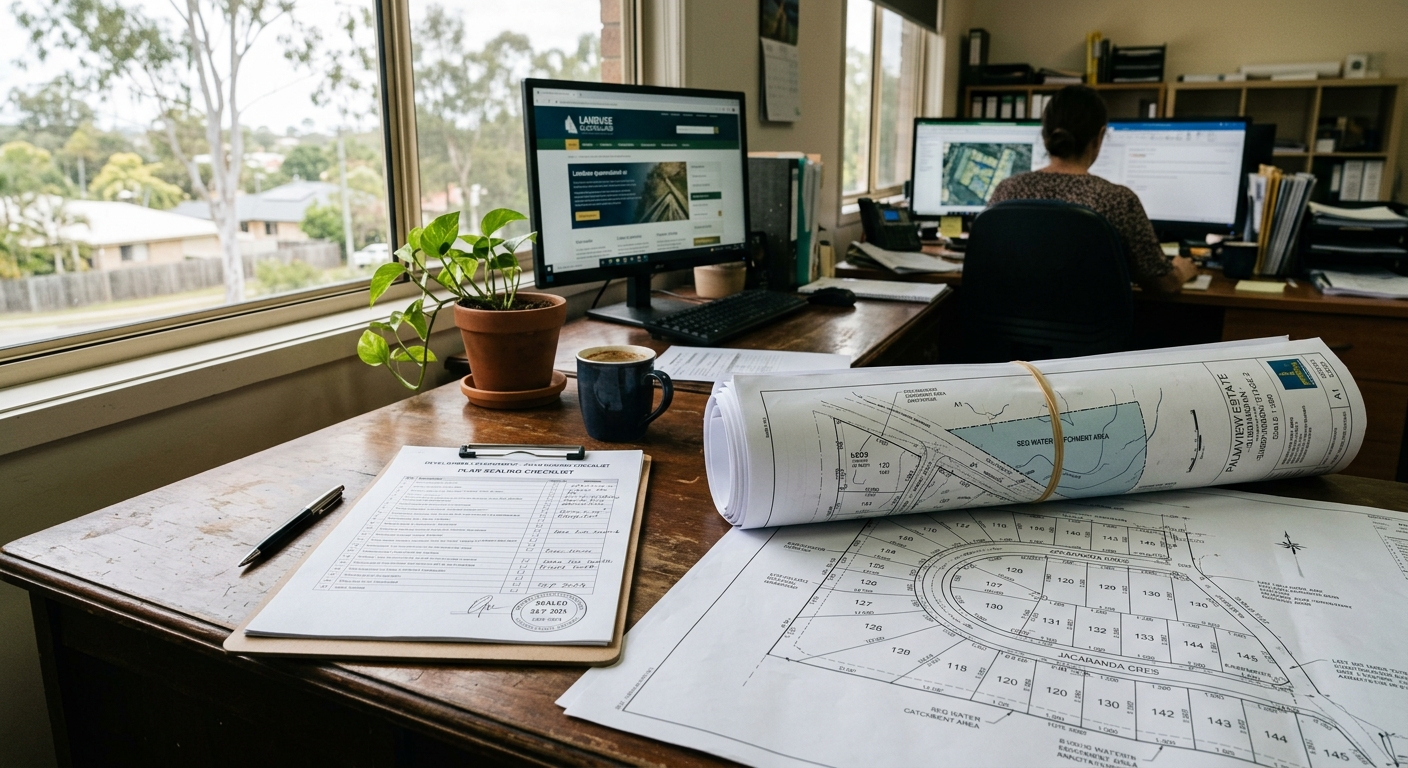
Plan sealing · Checklist
Plan Sealing Checklist for Queensland Subdivisions
Before a Queensland council will seal a survey plan, it checks that every relevant approval condition has been satisfied and the supporting evidence is in place. This checklist sets out what that evidence is, so the plan sealing request is a clean collation rather than a last-minute scramble.
Plan sealing is the step where a Queensland local government approves (seals) a survey plan for a subdivision before it is lodged with Titles Queensland for registration. The council will only seal the plan once it is satisfied that the relevant development approval conditions have been met, the required charges are paid, and the works and external sign-offs the approval depends on are complete. The checklist below is the evidence that demonstrates all of that in one place.
Where plan sealing sits in the process
Plan sealing sits at the very end of the subdivision process, after construction and just before titles issue. The council does not re-open the merits of the approval at this stage. It confirms that the conditions attached to the approval have been satisfied and that the survey plan is in a form it can seal. Once sealed, the plan is lodged with Titles Queensland, the State titles registry, where the new lots are registered and separate titles issue under the Land Title Act 1994.
Because the council is checking against the condition schedule, the quality of the plan sealing request depends almost entirely on how well conditions were tracked across the life of the project. A useful way to prepare is to work back through the development approval conditions one by one and confirm the evidence that satisfies each.
The plan sealing checklist
The following items are what Queensland councils commonly require before sealing a survey plan. The exact list varies by council and by the conditions on a given approval, so always read the specific approval and the council's own plan sealing (or plan of subdivision) lodgement requirements.
- Development approval conditions satisfied. Every condition that applies at or before the plan sealing stage has been actioned, with the evidence that demonstrates compliance collated against each one.
- Infrastructure charges paid. For a reconfiguring a lot (subdivision), the levied charge in the infrastructure charges notice is payable before the council approves the survey plan. Councils will not seal until outstanding charges are paid.
- Rates and other charges cleared. Councils commonly require rates and any other charges over the land to be paid up to date, including amounts not yet due, before they will sign the plan.
- Operational works completed and certified. Where the approval required civil works (roads, drainage, earthworks, services, landscaping), those works must be finished and certified, or secured by a bond for any uncompleted works, before sealing.
- External authority sign-offs. Confirmations from service and referral bodies, such as water and wastewater connection details, an electricity supply certificate, and telecommunications provisioning, are provided where the conditions require them.
- The survey plan and supporting documents. A survey plan prepared by a cadastral surveyor, together with any required community management statement, easements, and administrative sheets, in the form the council and Titles Queensland accept.
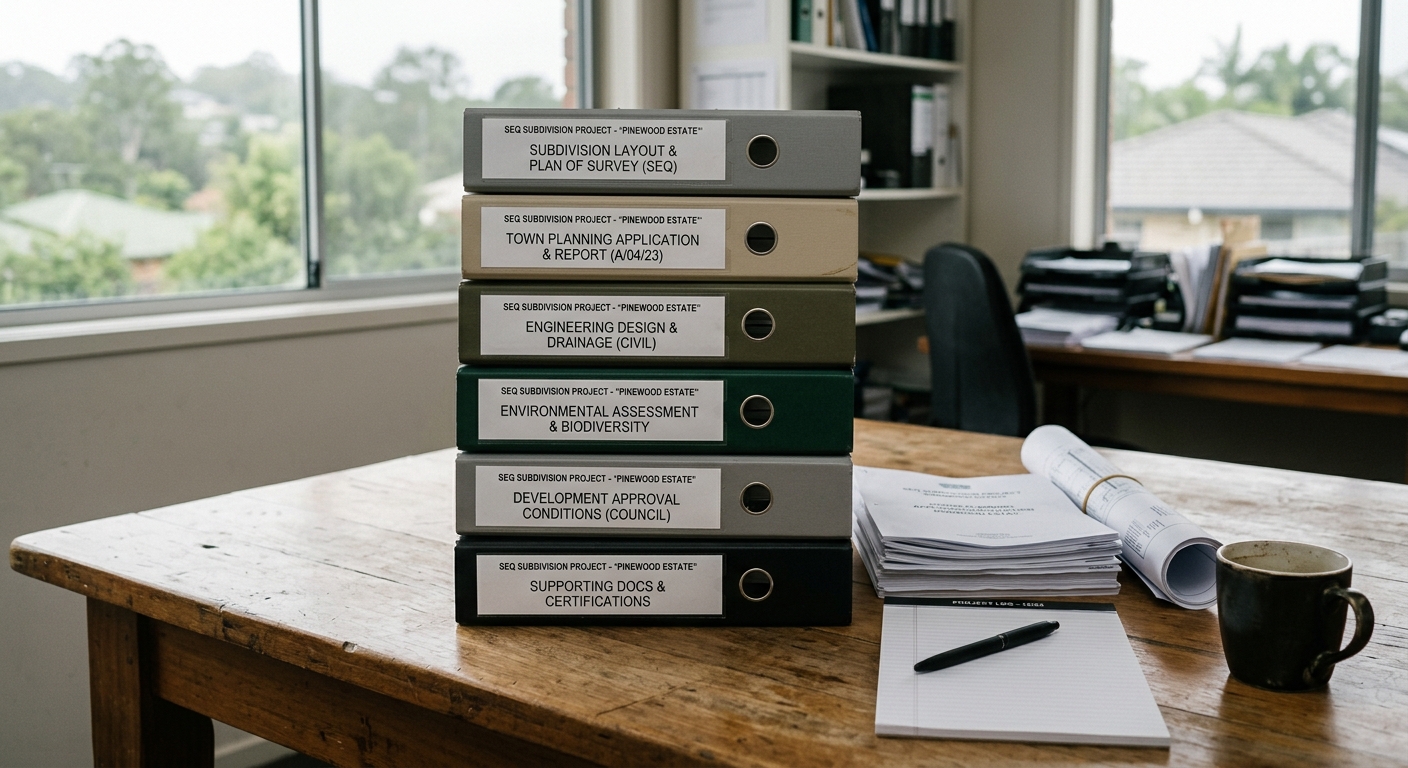
Why a complete request seals faster
A complete, well-organised plan sealing request is the single biggest lever on how quickly a plan seals, because it removes the council's need to issue requests for further information. Every missing document, unpaid charge, or uncertified work is a round trip: the council flags it, the team chases it, and the request sits idle in between. Assembling the checklist progressively, rather than at the end, is what keeps that dead time out of the schedule.
The time saved is real but specific. Preparing conditions properly does not shorten a council's own processing, and it will not speed up an external authority's clock. What it removes is the self-inflicted delay: the weeks lost reconstructing compliance, locating documents that should have been filed months earlier, and re-doing work that was addressed the wrong way.
The risk of an incomplete request
The largest financial exposure on a subdivision sits at this back end, because settlements are typically tied to registration, which cannot happen until the plan is sealed. A condition that was quietly missed early surfaces here, often with contracts already unconditional and buyers waiting. An external sign-off requested too late, or a charge that was not budgeted, can hold an otherwise finished project for weeks.
The checklist is really a risk register in disguise. Each item that is tracked and evidenced in advance is one that cannot become a surprise at the point where a surprise is most expensive. The failure modes are consistent and well understood, which is exactly why they are avoidable: see why plan sealing breaks down at the end for the patterns to watch.
Keeping the checklist under control
The most reliable way to keep a plan sealing checklist under control is to build it from the condition schedule on day one and update it as evidence is produced, not to assemble it at lodgement. That means turning the approval into a live register: each condition broken out, assigned an owner, linked to the stage it applies to, and backed by the document that satisfies it as that document is generated.
Two categories deserve early attention because they carry the longest lead times: infrastructure charges, which must be paid before the plan is sealed, and operational works, which must be built and certified. Actioning both early keeps them off the critical path at the moment everyone is waiting to settle. For the broader context of how plan sealing works across the State, see the overview of plan sealing in Queensland.
Frequently asked questions
What do you need before a survey plan can be sealed in Queensland?
Before a survey plan can be sealed in Queensland, a council needs the relevant development approval conditions satisfied, infrastructure charges and rates paid, any required operational works completed and certified (or bonded), external authority sign-offs where conditioned, and the survey plan and supporting documents in an acceptable form. The exact list depends on the council and the conditions on the approval.
Who seals the plan, and what happens after it is sealed?
The local council (the assessment manager for the subdivision) seals the survey plan once it is satisfied the conditions are met. After sealing, the plan is lodged with Titles Queensland for registration, where the new lots are created and separate titles issue under the Land Title Act 1994.
Do infrastructure charges have to be paid before plan sealing?
Yes. For a reconfiguring a lot (subdivision), the infrastructure charge levied in the infrastructure charges notice is payable before the council approves the survey plan, so councils will not seal the plan while charges remain outstanding.
How can you make plan sealing faster?
The most effective way to shorten plan sealing is to lodge a complete, well-organised request so the council does not need to issue requests for further information. Tracking conditions from the day the approval issues, and actioning long-lead items such as infrastructure charges and operational works certification early, is what keeps the timeline tight.
A plan sealing checklist is not paperwork for its own sake. It is the proof that a subdivision is genuinely ready to become registered, sellable lots. Built progressively from the condition schedule, it turns the final stage from a bottleneck into a formality.
Learn more about PlanEase
PlanEase turns a development approval into a live condition register, so the plan sealing checklist is complete and evidenced long before you lodge.
See how PlanEase works →