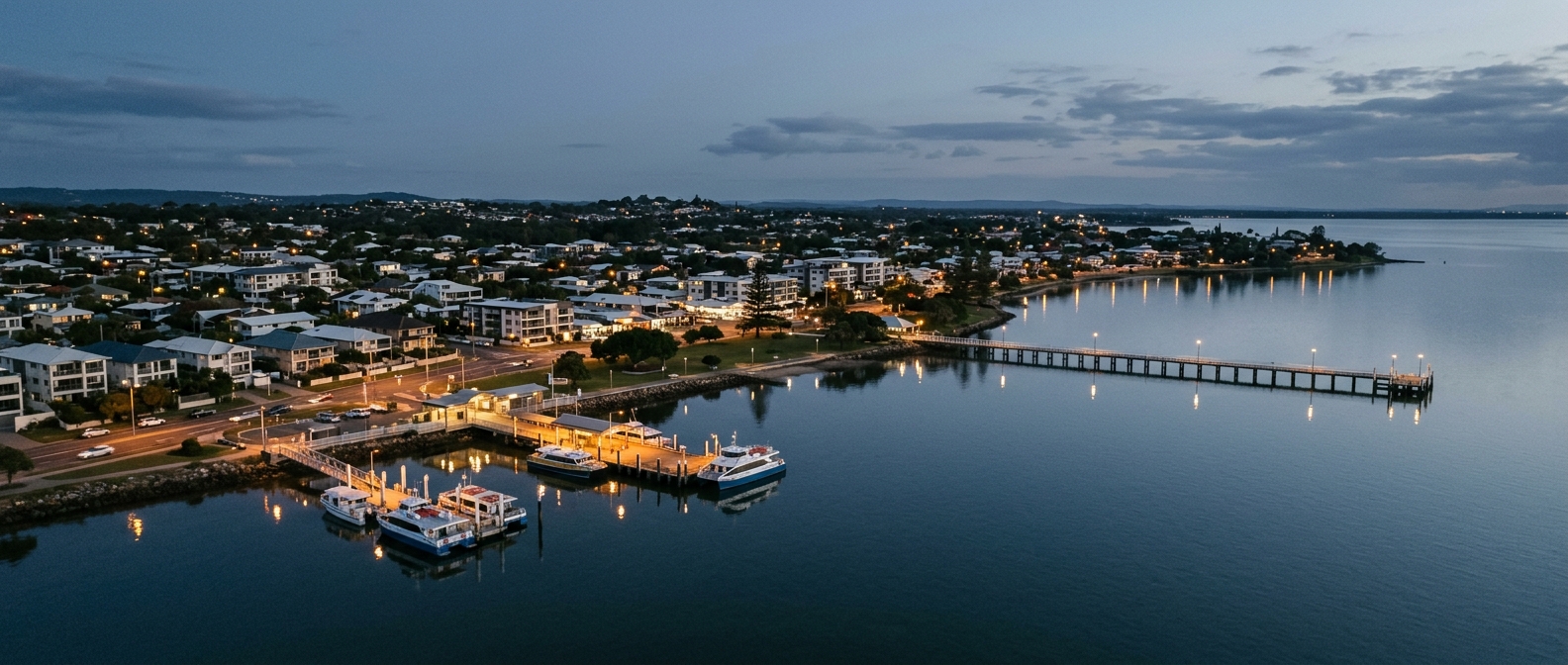
DA conditions · Toondah Harbour PDA
Toondah Harbour PDA: Development Conditions and Plan Sealing
Toondah Harbour is a waterfront Priority Development Area at Cleveland, assessed by Economic Development Queensland with Redland City Council.
The Toondah Harbour Priority Development Area (PDA) is an EDQ-assessed waterfront site at Cleveland, on the southern shores of Moreton Bay in Redland City. Development conditions here are set through the PDA framework rather than the standard council development approval pathway, which changes who assesses your application, what it is assessed against, and how conditions flow through to plan sealing.
Toondah Harbour was declared a Priority Development Area on 21 June 2013 at the request of Redland City Council, and the Toondah Harbour PDA Development Scheme commenced on 29 May 2014. The PDA covers about 67 hectares, including roughly 17.5 hectares of land and 49.5 hectares of water within Moreton Bay. It sits approximately one kilometre from the Cleveland CBD and about 33 kilometres from central Brisbane, functioning as the mainland gateway to North Stradbroke Island (Minjerribah).
For developers and surveyors, the practical point is this: inside the PDA, PDA development approvals carry conditions that must be tracked, evidenced, and cleared before a survey plan can be sealed. Managing those conditions from approval through to registration is what separates projects that settle on time from those that stall.
How Toondah Harbour PDA conditions are structured
In the Toondah Harbour PDA, development applications are assessed by Economic Development Queensland (EDQ), together with Redland City Council, against the PDA Development Scheme rather than the Redland City Plan. This is a distinct pathway from a standard reconfiguring a lot approval under the Planning Act 2016. According to Economic Development Queensland, Economic Development Queensland (EDQ) assesses development applications together with Redland City Council
and all development applications within the PDA are assessed against the Development Scheme.
The statutory basis is the Economic Development Act 2012 (the ED Act). Under that Act, the Minister for Economic Development Queensland (MEDQ) can set and levy infrastructure charges within a PDA. For Toondah Harbour, EDQ applies its Infrastructure Funding Framework, which in turn refers to the relevant local government charging instrument to calculate charges. That means charges and infrastructure obligations still connect back to Redland City Council settings, even though the approval itself runs through EDQ.
A PDA development approval typically carries a condition schedule covering infrastructure, engineering, stormwater, public realm, and, on a waterfront site like Toondah Harbour, marine and environmental requirements. Larger projects usually require separate operational works approvals, and the conditions attached to those approvals feed directly into the plan sealing stage. Each of those obligations needs to be tracked to a clear owner and closed out with evidence.
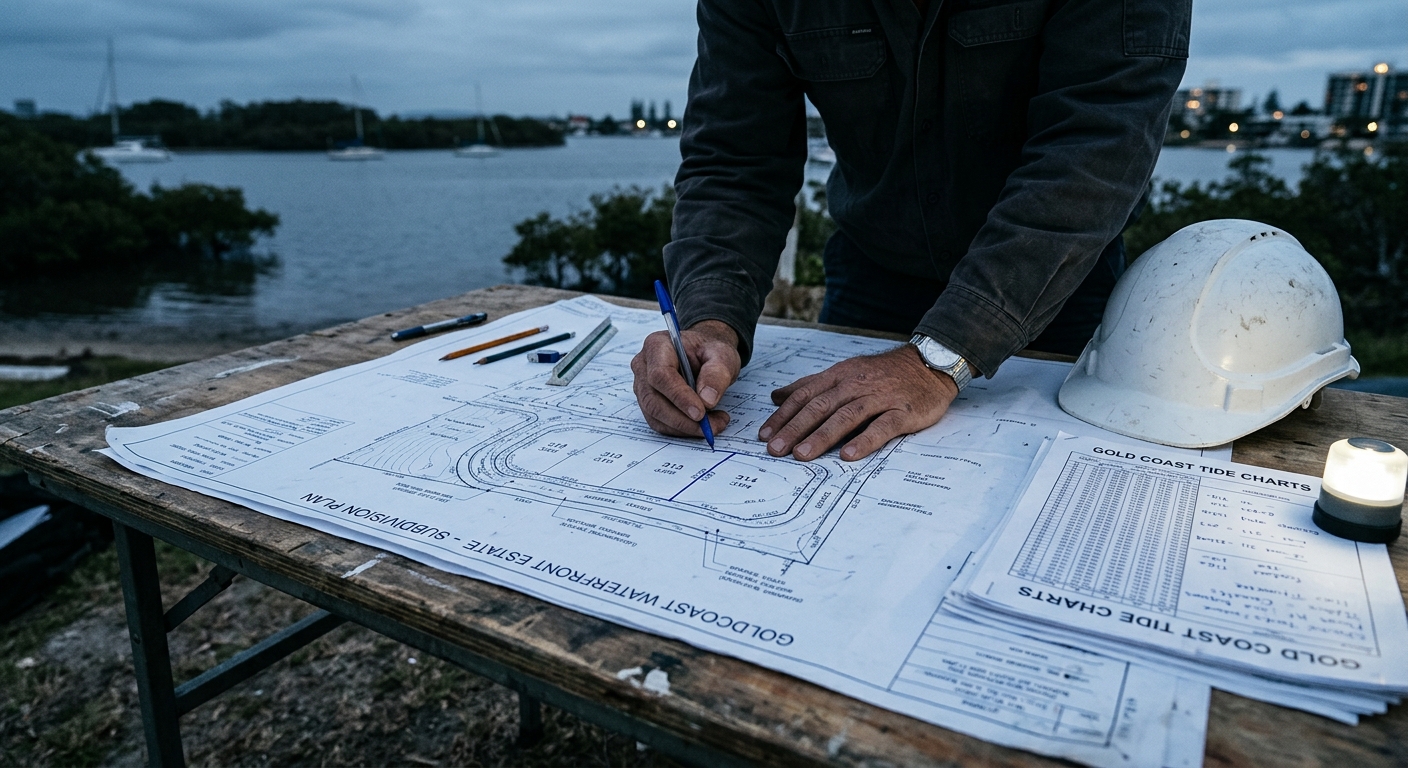
Where Toondah Harbour PDA projects run into problems
The most reliable source of delay on PDA projects is treating condition compliance as an end-stage task. Toondah Harbour is a good example of why the PDA context adds complexity: the site sits within the internationally significant Moreton Bay Ramsar wetlands, and the environmental sensitivity of the location has shaped the project's history in a way that ordinary suburban subdivisions never face.
That history matters for anyone planning around this site. The long-running Walker Corporation redevelopment proposal for Toondah Harbour was withdrawn on 18 April 2024, after the then federal Environment Minister proposed to refuse it under the Environment Protection and Biodiversity Conservation Act 1999 (EPBC Act) on environmental grounds. The PDA declaration itself remains in place, but the pathway for large-scale redevelopment stayed unsettled after the withdrawal. The lesson for developers and surveyors is that federal environmental approvals, state PDA conditions, and local infrastructure obligations can each move on their own timeline, and any one of them can hold up the whole project.
On more conventional PDA projects, the same fragmentation risk applies at a smaller scale. Engineers, planners, and surveyors each hold part of the compliance picture, and without a shared record, conditions get addressed reactively. Operational works certification and external sign-offs are the items most often left outstanding, and they surface too late, at the point of plan sealing preparation, when there is no time left to resolve them without delaying settlement.
Time savings from structured condition management
PDA projects that identify their heaviest conditions early and manage them as active workstreams avoid the delays that come from leaving compliance to the plan sealing phase. The processes are known: the time saving comes from starting them early enough to complete them without urgency.
Decision times give a sense of the front of the pipeline. Based on PlanEase's own analysis of public Queensland council and EDQ development-application registers, Redland City Council's typical (median) time to a decision was about 20 days over the period from 18 May 2026 to 14 August 2026, close to the statewide median of about 26 days across the sources tracked. Those figures cover the decision stage only. The post-approval stage, satisfying conditions and getting to a sealed plan and registered title, is the part that is rarely measured and is where months quietly disappear.
18 May 2026 to 14 August 2026, per PlanEase analysis of public Queensland council and EDQ registers. EDQ is cited by volume only and has no published decision-time figure.
Approximate figures from PlanEase's analysis of public registers, data updated 16 August 2026, subject to revision. Not official statistics.
A complete first submission at plan sealing proceeds on the expected timeframe. An application with outstanding matters generates requests that add weeks. On a PDA project with EDQ and Redland City Council both involved, a complete lodgement is the single most reliable time saving available. See PlanEase's data hub at Queensland DA decision times and volumes for how the measured front of the pipeline contrasts with the unmeasured post-approval stage.
Risk reduction for Toondah Harbour PDA development
The financial exposure on a PDA subdivision is the same as any major Queensland project: unconditional contracts, finance facilities drawn, holding costs accruing, and purchasers with fixed plans. A delayed plan sealing pushes out settlement, and every week of delay carries a real cost.
The specific risk at Toondah Harbour comes from the layered approval framework: EDQ assessment against the PDA Development Scheme, Redland-linked infrastructure charges, operational works conditions, and, for anything touching the bay, environmental requirements. A structured condition register that keeps the full compliance position visible, and current, as the project progresses is the most reliable way to manage that risk. See plan sealing in Priority Development Areas for how the PDA process differs from standard council plan sealing.
Practical approach to Toondah Harbour condition management
Review the full PDA condition schedule at approval, and flag the conditions that need the most lead time first: operational works certification, infrastructure charge payments, and any external or environmental sign-offs. Confirm early which requirements sit with EDQ, which connect back to Redland City Council, and which depend on other agencies, so that responsibility is clear from the outset.
Because Toondah Harbour is an EDQ-assessed PDA rather than a standard Redland approval, do not assume the process mirrors a conventional council reconfiguration. For contrast, the standard Redland pathway is set out on our Redland City Council DA conditions page, and the broader mechanics of EDQ assessment are covered in EDQ development approvals and conditions compliance.
PlanEase supports structured condition management for PDA and council subdivision projects across Queensland: tracking conditions from approval, assigning responsibility, and building the compliance record progressively. See also managing DA conditions across a project.
Frequently asked questions
Who assesses development applications in the Toondah Harbour PDA?
Economic Development Queensland (EDQ) assesses development applications in the Toondah Harbour PDA together with Redland City Council, and all applications are assessed against the Toondah Harbour PDA Development Scheme rather than the Redland City Plan. The PDA operates under the Economic Development Act 2012, so the approval pathway differs from a standard council development approval under the Planning Act 2016.
When was Toondah Harbour declared a Priority Development Area?
Toondah Harbour was declared a Priority Development Area on 21 June 2013 at the request of Redland City Council, and the Toondah Harbour PDA Development Scheme commenced on 29 May 2014. The PDA covers about 67 hectares at Cleveland on the southern shores of Moreton Bay, including roughly 17.5 hectares of land and 49.5 hectares of water.
What happened to the Walker Corporation redevelopment proposal?
The Walker Corporation redevelopment proposal for Toondah Harbour was withdrawn on 18 April 2024, after the then federal Environment Minister proposed to refuse it under the Environment Protection and Biodiversity Conservation Act 1999 on environmental grounds relating to the Moreton Bay Ramsar wetlands. The PDA declaration itself remains in place. The episode shows how federal environmental approvals can sit alongside state PDA conditions and local infrastructure obligations, each on its own timeline.
How do infrastructure charges work in the Toondah Harbour PDA?
Under the Economic Development Act 2012, the Minister for Economic Development Queensland can set and levy infrastructure charges within a PDA. For Toondah Harbour, EDQ applies its Infrastructure Funding Framework, which refers to the relevant local government charging instrument to calculate the charges. That means the charge calculation still connects back to Redland City Council settings even though the approval runs through EDQ.
How do PDA conditions affect plan sealing?
PDA development approvals carry condition schedules, and any operational works approvals carry their own conditions, all of which must be satisfied and evidenced before a survey plan can be sealed. Tracking conditions from approval, assigning clear responsibility, and clearing external and environmental sign-offs progressively is what allows a complete plan sealing application to be lodged and to proceed to registration without avoidable delay.
Toondah Harbour PDA conditions reflect an EDQ-assessed waterfront site with genuine environmental complexity and a layered approval framework. Projects that track conditions from approval and address them progressively arrive at plan sealing ready to lodge a complete application and move to registration without the last-minute friction that delays settlement.
Learn more about PlanEase
Structured DA and PDA condition management for Toondah Harbour and Redland City subdivision projects.
See how PlanEase works →