
DA conditions · Plain English guide
What Are DA Conditions?
DA conditions are the requirements a council attaches to a development approval that must be satisfied before a project can proceed and, for a subdivision, before the plan can be sealed and new titles registered. This is a plain English guide to what they are, who imposes them, and why they matter in Queensland.
In Queensland, a development approval (DA) is rarely a simple yes. It usually comes with a schedule of conditions: the specific things you must do, pay, build, or prove for the approval to be given full effect. DA conditions are the fine print that turns an approval into a set of obligations, and on a subdivision they are the difference between an approved project and a registered, sellable lot.
What DA conditions actually are
DA conditions are the requirements attached to a development approval that a developer must meet for the approval to take effect and the development to lawfully proceed. They are imposed when the approval is decided and set out in the decision notice. A single approval can carry anywhere from a handful of conditions to well over a hundred, covering everything from road works and drainage to landscaping, easements, contributions, and reporting.
Conditions are not unlimited. Under section 65 of the Planning Act 2016, a development condition must be relevant to, but not an unreasonable imposition on, the development, or else be reasonably required in relation to it. That test, long established in Queensland planning law, is what keeps conditions tethered to the development they attach to rather than being a means to extract unrelated benefits.
Who imposes DA conditions
In Queensland, DA conditions come from two sources. The assessment manager, which for most development is the local council, decides the application and imposes conditions under the Planning Act 2016. Where an application is referred to another body, a referral agency can direct the assessment manager to impose stated conditions, or give advice, under the same Act. Common referral agencies include the Department of Transport and Main Roads for state-controlled roads, and distributor-retailers and network providers for water and electricity infrastructure.
This is why a single decision notice can contain conditions authored by several different bodies. The council's own conditions sit alongside conditions the council was directed to impose by a referral agency. To the developer they all read as one schedule, but they can involve very different parties when it comes to demonstrating compliance.
The main types of DA conditions
DA conditions vary by project, but most fall into a few broad groups. Understanding the type helps you understand who satisfies it, when, and what evidence council will want to see.
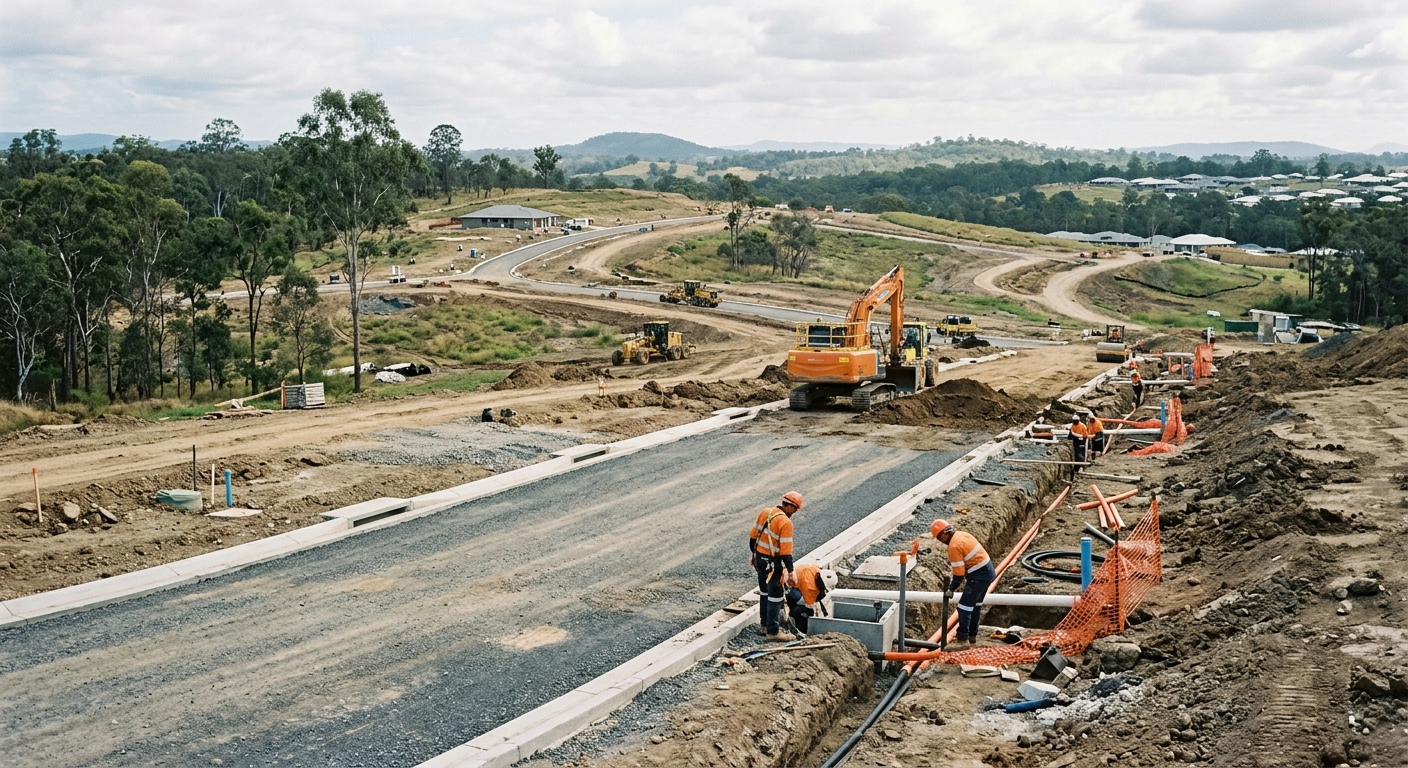
- Infrastructure conditions. Requirements to build or upgrade physical works: roads, footpaths, stormwater drainage, water and sewer connections, parks. These are usually satisfied through construction and then certification that the works were built to the approved design.
- Financial conditions. Payments and securities, most commonly infrastructure charges levied under a council's adopted charges resolution, plus maintenance bonds or bank guarantees. These generally have to be paid or lodged before the plan is sealed.
- Operational and design conditions. Requirements about how the development is designed, built, or run: landscaping, acoustic treatment, hours of operation, environmental management, and similar controls set out in the approval.
- Legal and administrative conditions. Easements to be created, land to be dedicated, plans to be endorsed, or reports to be submitted. These are satisfied by producing the right document at the right stage.
How DA conditions flow through to plan sealing
For a subdivision, DA conditions are the checklist that stands between approval and titles. Before a survey plan can be sealed by the council and registered with the Titles Registry, the council must be satisfied that the relevant conditions have been met. That is the point at which every condition, and the evidence that it was satisfied, has to be accounted for.
The practical trap is that conditions are issued at the start of a project but only tested at the end. Evidence accumulates slowly and unevenly over months or years, and if it has not been tracked against each condition as it was produced, plan sealing becomes a scramble to reconstruct compliance. See why plan sealing breaks down at the end for how this plays out, and managing DA conditions across a project for how to avoid it.
Why managing conditions matters
DA conditions are known from the day the approval is issued, yet they are one of the most common causes of delay in getting a subdivision to settlement. The reason is almost never that a condition is difficult in isolation. It is that conditions are managed informally, across emails and spreadsheets, until the plan sealing stage exposes what was missed. Treating the condition schedule as a live record from the outset, with clear ownership and evidence collected as it is produced, is what keeps a project moving.
Frequently asked questions
What are DA conditions in simple terms?
DA conditions are the requirements a council attaches to a development approval that you must satisfy for the development to proceed. They can require you to build infrastructure, pay charges, create easements, or meet design and operational standards, and for a subdivision they must be met before the plan can be sealed and titles registered.
Who sets DA conditions in Queensland?
The assessment manager, usually the local council, decides the application and imposes conditions under the Planning Act 2016. Where the application is referred, a referral agency such as the Department of Transport and Main Roads can direct the council to impose stated conditions, or give advice. A single approval can therefore carry conditions from more than one body.
What are the main types of DA conditions?
Most DA conditions fall into a few groups: infrastructure conditions for physical works like roads and drainage, financial conditions such as infrastructure charges and bonds, operational and design conditions covering how the development is built and run, and legal or administrative conditions like easements and land dedications.
Can a DA condition be unreasonable or challenged?
Conditions must meet a legal test. Under section 65 of the Planning Act 2016, a condition must be relevant to, but not an unreasonable imposition on, the development, or else be reasonably required in relation to it. A condition that fails this test can be queried with the council or challenged, so it is worth reviewing a schedule against it early.
How do DA conditions affect plan sealing?
For a subdivision, the council must be satisfied that the relevant DA conditions have been met before it will seal the survey plan, and the plan must be sealed before it can be registered with the Titles Registry. Outstanding or undocumented conditions are the most common reason a plan sealing application stalls.
DA conditions are simply the terms of a development approval, but for a subdivision they carry real weight: every one has to be satisfied and evidenced before the plan can be sealed and titles created. The projects that move smoothly are the ones that treat the condition schedule as a live obligation from day one, not a document to revisit at the end.
Learn more about PlanEase
A clear, structured way to track DA conditions from approval through to plan sealing.
See how PlanEase works →