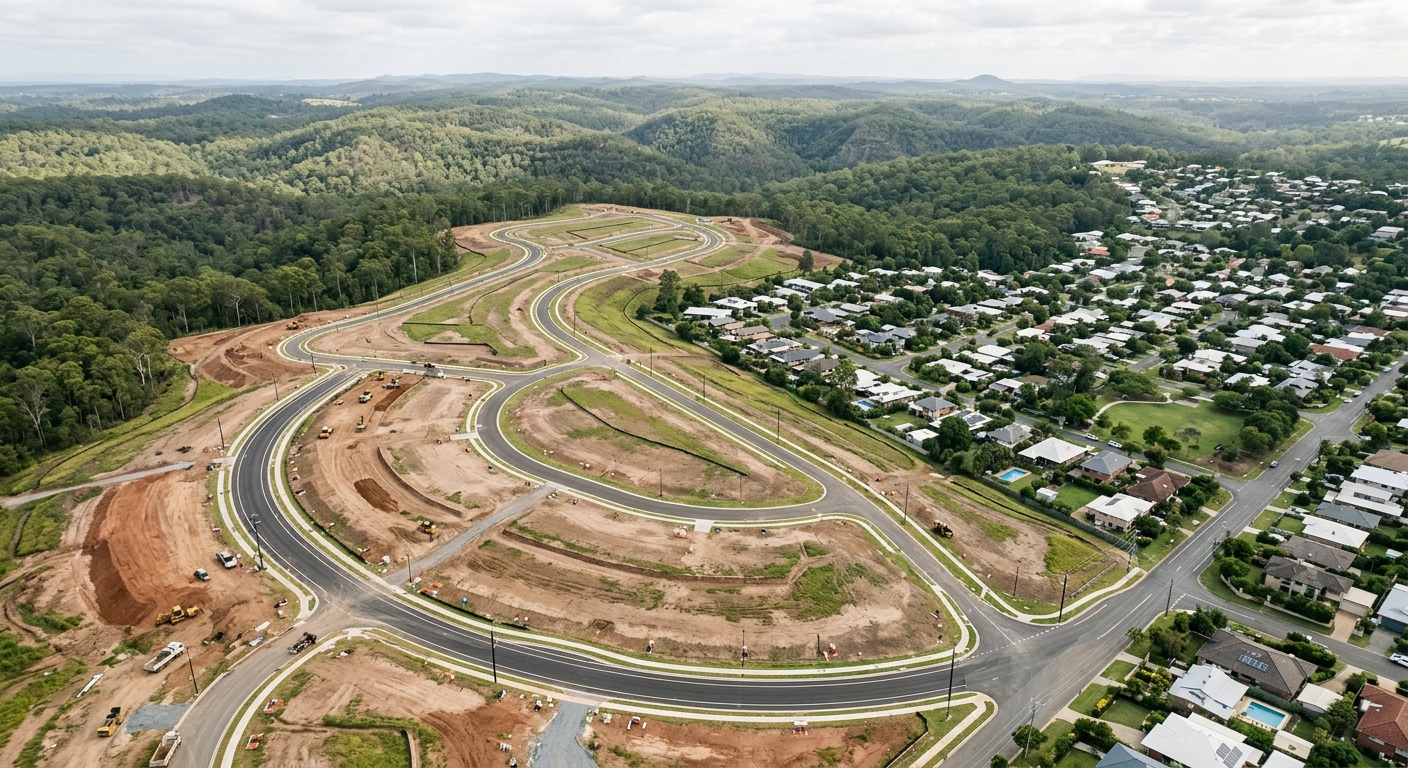
Plan sealing · South East Queensland
Subdivision Plan Sealing in South East Queensland
Subdivision plan sealing in South East Queensland involves satisfying a specific set of council requirements before a registered survey plan can create new lots on title.
Across Brisbane, the Gold Coast, Logan, Ipswich, and the Sunshine Coast, the process follows the same legislative framework, but the specific conditions, timeframes, and council expectations vary considerably.
How the process typically works
A subdivision development approval in Queensland comes with a condition schedule. These conditions govern what must be completed or demonstrated before the plan can be sealed. They typically include infrastructure works (roads, stormwater, water and sewer connections), contributions (infrastructure charges, open space), easements, and compliance certifications from relevant authorities and utilities.
Once construction is underway or complete, the project surveyor prepares the survey plan and lodges a plan sealing application with the relevant council. For staged subdivisions, this may occur multiple times across the life of the project as each stage is completed.
Council assesses the application, checks that each condition in the approval has been addressed, and confirms that supporting documentation (engineering certificates, authority approvals, maintenance bonds, payment receipts) has been provided. Only then is the plan sealed and forwarded for registration.
In SEQ, councils including Brisbane City Council, Gold Coast City Council, Logan City Council, Ipswich City Council, and Sunshine Coast Council each have their own forms, checklists, and submission requirements. Staying across these differences is a practical challenge for consultants working across multiple LGAs.
Where projects run into issues
The majority of delays in subdivision plan sealing come back to the same root causes, regardless of council area.
- Conditions managed informally. The DA approval is issued and conditions are logged, sometimes in a spreadsheet, sometimes not at all. By the time the plan sealing application is being prepared, no one has a clear picture of what's been done and what hasn't.
- Documents held by different parties. The engineer holds the infrastructure certificates. The developer holds payment receipts. The planner holds the council correspondence. The surveyor has to chase all of it to put together the application.
- Staged approval complexity. Multi-stage subdivisions create layered condition schedules. Conditions from earlier stages may roll over into later stages, and keeping track of what applies where becomes a project management challenge in itself.
- Council referrals and external authority sign-offs. Conditions that require responses from Unitywater, Energex, the Department of Transport, or other external bodies introduce additional waiting periods that need to be tracked and followed up.
Improving the process
Subdivision projects that move through plan sealing smoothly tend to share a consistent habit: they treat the condition schedule as a live document from the moment the DA is issued. Each condition is assigned to the right consultant or team member. Evidence is collected and logged progressively. By the time the plan sealing application is being assembled, most of the work is already done.
This isn't about adding complexity to the process; it's about removing the scramble at the end. When conditions are tracked properly throughout construction, the plan sealing application becomes a collation exercise rather than an investigation.
The other lever is early engagement with council. Understanding which conditions are likely to require additional sign-off time, and starting that process early, can significantly reduce the gap between practical completion and plan registration.
Using a structured system
PlanEase provides a structured workflow for managing subdivision plan sealing across SEQ projects. Conditions from the DA are extracted and organised within the platform, with responsibility assigned to the relevant party: surveyor, planner, engineer, or developer.
- Condition tracking from DA issue through to plan sealing lodgement
- Document attachment against individual conditions
- Multi-stage subdivision support with condition inheritance
- AI-assisted condition structuring and assessment
- Shared visibility across the project team
The platform is designed for the way subdivision projects actually work, with multiple parties involved, conditions that span months or years, and real consequences for delays.
Frequently asked questions
What councils are involved in plan sealing across SEQ?
Plan sealing in SEQ is handled by the relevant local government: Brisbane City Council, Gold Coast City Council, Logan City Council, Ipswich City Council, Sunshine Coast Council, Moreton Bay City Council, and others. Each has its own submission requirements and internal processes.
Can you seal individual stages of a subdivision separately?
Yes. Staged subdivisions typically involve a separate plan sealing application for each stage. Conditions may be stage-specific or may apply across all stages. Managing which conditions apply to which stage, and what evidence is required, is one of the more complex aspects of multi-stage project administration.
What documents are typically required for a plan sealing application?
Requirements vary by council and project, but typically include: the survey plan, engineering certificates, infrastructure charge receipts, maintenance bond documentation, easement documentation, relevant authority approvals (Unitywater, Energex, etc.), and the completed council application form.
Who lodges the plan sealing application?
The application is typically lodged by the project surveyor, though the supporting documentation is gathered from multiple parties including the town planner, civil engineer, and developer. Coordinating this across teams is often where delays occur.
Subdivision plan sealing in SEQ is a well-defined process, but managing the conditions and documentation that sit behind it requires consistent effort across the project lifecycle. The teams that do it well treat compliance tracking as an ongoing task, not a final sprint.
Learn more about PlanEase
Structured plan sealing and condition management for SEQ subdivision projects.
See how PlanEase works →