Plan sealing · Analysis
Inconsistent Submission Quality in Plan Sealing
Plan sealing applications in Queensland vary significantly in quality. Some are well-organised, clearly referenced, and straightforward to assess. Others arrive with missing documents, outdated plans, incorrect certificates, or conditions that have been partially addressed without explanation.
The inconsistency isn't usually a capability problem. The consultants involved know what's required. The issue is that the information hasn't been managed in a way that makes a clean submission straightforward to produce.
Poor submission quality has direct consequences: for councils processing applications and for project teams waiting on plan sealing to complete before titles can be registered.
How this shows up on projects
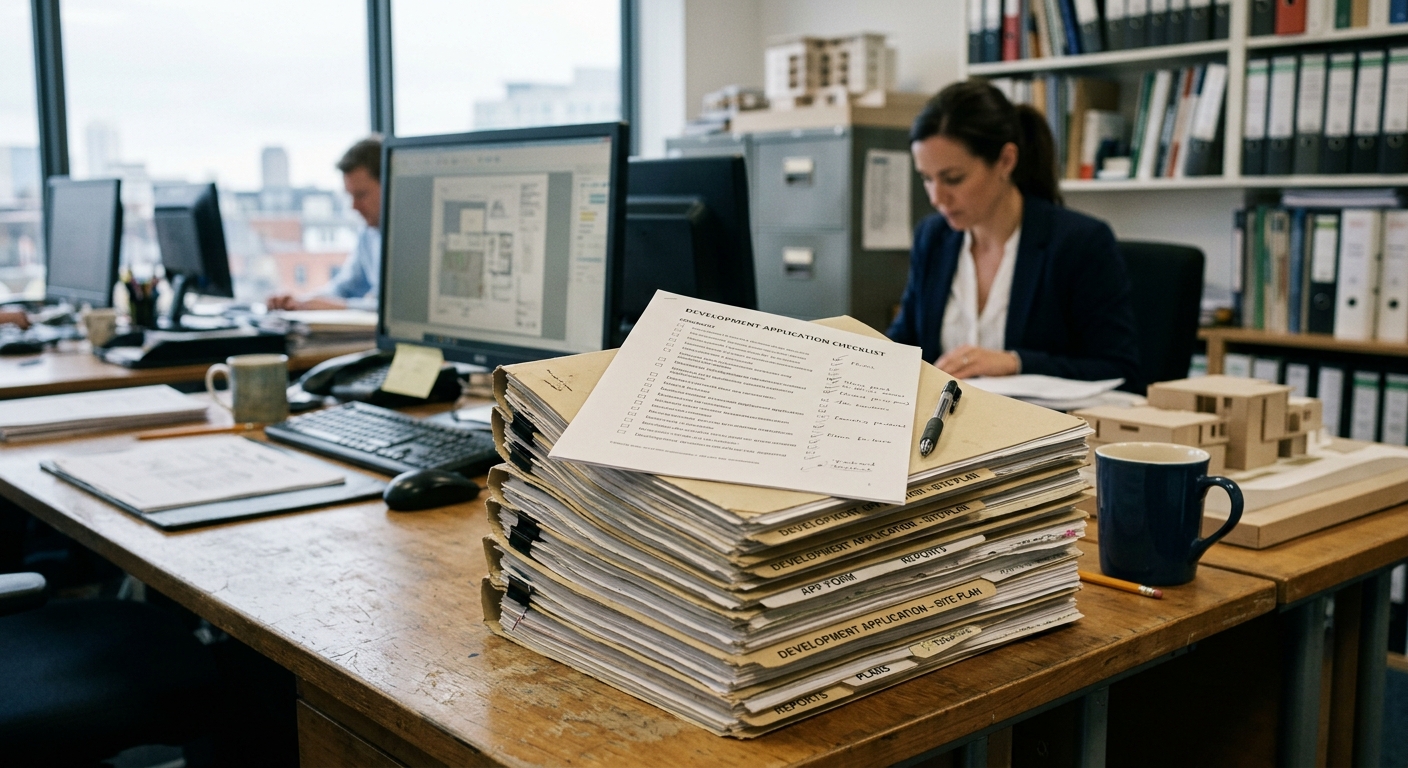
The application arrives at council with a covering letter and a folder of documents. The folder contains engineering certificates, drainage reports, landscape plans, infrastructure charge receipts, and correspondence with referral agencies. Nothing is indexed against the condition schedule. The assessor has to work through each document and determine which condition it addresses.
One of the engineering certificates is dated eighteen months ago and refers to a design that was subsequently revised. The revised design is also in the folder. It's not clear which one the certificate applies to.
Three conditions relating to infrastructure contributions have been marked as addressed. The covering letter references payment of the relevant charges. The receipt is not included.
Council issues a request for additional information. The project team spends a week locating the receipt, confirming which certificate version is current, and resubmitting. The plan sealing timeline extends by three weeks.
Why it happens
Applications are assembled at the end of the project from whatever has been collected. Documents accumulate in shared drives, email threads, and individual inboxes across multiple organisations. When it's time to lodge, someone has to pull them together quickly.
Version control is a recurring issue. Projects generate multiple iterations of technical documents. Without a system for tracking which version is current and whether it's been accepted by council, old documents end up in submissions alongside new ones.
There's also a translation problem between how documents are filed and how conditions are structured. A drainage report might satisfy three different conditions. A maintenance bond covers one condition and partially addresses another. Without a deliberate process of linking documents to conditions, the relationship between the evidence and the requirement isn't clear in the application.
Time pressure at lodgement compounds everything. Applications go out before they're fully checked because the commercial timeline doesn't allow for a thorough review.
Impact on plan sealing
Incomplete or poorly organised applications generate requests for additional information. Each request takes time, typically at least a week for the project team to respond and council to review. Multiple rounds of requests extend the timeline significantly.
There is also a reputational dimension. Surveyors and planners who regularly submit well-organised applications build a track record with council. Applications that are consistently disorganised create a different kind of relationship, one that doesn't benefit the project.
For the developer, inconsistent submission quality is often invisible until it causes a delay. At that point, it's already too late to address the underlying information management problem. The only option is to fix the specific gap as quickly as possible.
Consistent, high-quality submissions require a consistent process. They can't be produced by working harder at the end. They require the information to have been managed properly throughout the project.
Improving the process
The core improvement is linking documents to conditions progressively rather than assembling them from scratch at the end. When each certificate, receipt, and sign-off is attached to the specific condition it satisfies at the time it's produced, the application is built over time rather than assembled under pressure.
Version control requires a deliberate approach. The current version of each document should be clearly identified and previous versions archived, not left in the same folder. When a document is superseded, the record should reflect that.
A pre-lodgement review (working through each condition and confirming that the evidence on file is current and sufficient) is a straightforward quality control step that most projects skip. For complex or large applications, this review is worth the time it takes.
Organising the application around the condition schedule (rather than providing a document folder and leaving the relationship between documents and conditions implicit) makes the assessor's job easier and reduces the likelihood of follow-up.
Using a structured system
PlanEase structures the plan sealing application around the DA condition schedule. Documents are linked to individual conditions as they're produced. Version history is maintained. The current state of each condition (what's been addressed, what evidence is attached, what's still outstanding) is visible before lodgement.
The application that comes out of this process is organised around conditions rather than documents. Each condition has the evidence attached. Outstanding items are identified before submission rather than by council during assessment.
Practical benefits
- Documents linked to conditions as they're produced, not assembled at the end
- Version control maintained across technical documents
- Application organised around the condition schedule
- Outstanding items visible before lodgement
- Reduced requests for additional information from council
- Consistent quality across multiple projects and lodgements
Frequently asked questions
What are the most common reasons council requests additional information?
Missing documents are the most common cause: certificates, receipts, or authority approvals that weren't included. Outdated documents are the second most common: plans or certificates that have been superseded but weren't updated in the submission. Conditions that have been partially addressed without explanation are also a frequent source of requests.
How long does council take to respond to a request for additional information?
Council's assessment clock typically pauses when a request for additional information is issued and resumes when the information is received. The overall effect on the project timeline depends on how quickly the project team can respond. Simple gaps (a missing receipt) can be resolved in a day or two. More complex issues take longer.
Is there a standard format for plan sealing applications in Queensland?
There is no single standard format across all Queensland councils. Each council has its own forms and submission requirements. The common expectation across councils is that the application clearly demonstrates how each condition in the DA approval has been satisfied, supported by appropriate evidence.
Can submission quality affect how quickly council processes a plan sealing application?
A complete, well-organised application is faster to assess than one with gaps or unclear referencing. Applications that require the assessor to chase down which document addresses which condition, or that generate requests for additional information, take longer, both because of the inherent back-and-forth and because resubmissions restart or extend parts of the assessment process.
Submission quality in plan sealing is a direct output of how information has been managed across the project. Teams that manage conditions and documents progressively produce better applications, not because they work harder at the end, but because the work has already been done.
Learn more about PlanEase
Structured document and condition management for plan sealing in Queensland.
See how PlanEase works →